Lawful Relief of Command
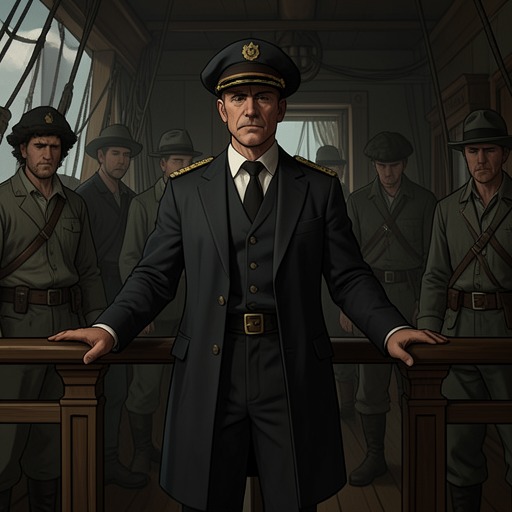
The Caine Mutiny Court-MartialLawful Relief of Command concerns the narrow and dangerous boundary between preserving the chain of command and acting when a commanding officer may be unable to meet an emergency. The Caine case makes that boundary more than a question of regulation: it tests what counts as an extreme peril, who is competent to judge another officer’s fitness, and whether a subordinate can be punished for an intervention that appears necessary in the moment but irregular under naval discipline.
The Rule and Its Exception
The case’s official formulation begins with a governing principle: a ship can have only one commanding officer, appointed by the government. The Navy’s later review argued that a second-in-command exceeded his authority by removing that officer without referring the matter to the highest available authority. It treated Articles 184, 185, and 186 not as a general license to replace a captain whenever a subordinate disagreed with his decisions, but as provisions for exceedingly rare circumstances. In the review’s view, those articles reinforced the usual chain of command rather than weakening it.
That doctrine does not make the decision self-evident. Its force depends on the distinction between ordinary disagreement and an emergency grave enough to justify exceptional action. The question is not simply whether the executive officer believes the captain is wrong, but whether conditions have reached the last extremity and whether there is time or a practicable means to seek higher authority. The Caine dispute turns on this threshold: a rule designed to prevent unauthorized command changes must still confront the possibility that obedience itself could expose a ship to danger.
Emergency Judgment at Sea
During the typhoon, Willie Keith could not understand the maneuver Steve Maryk was making. The wind was turning the Caine from south toward west; Queeg had been trying to force it back south, while Maryk used the ship’s momentum and the power of engine and rudder to swing its bow north, into the wind and sea. The maneuver was, in calmer conditions, comprehensible. In the crisis, Willie had lost his bearings and faith in the ship. Sitting in water on the deck and clinging to a telephone jackbox, he could think only of being saved. His experience shows how little an observer’s terror may reveal about the technical judgment being exercised at the center of a crisis.
The subsequent courtroom question made the legal threshold explicit. Greenwald asked Queeg whether, at the moment he was relieved on the morning of December 18, 1944, the Caine was in the last extremity. Queeg answered that it certainly was not. That answer was part of the evidentiary contest over whether Maryk’s action fell within the exceptional circumstances contemplated by naval regulations; it did not, by itself, resolve the competing account of the ship’s peril. The court had to consider the claimed emergency alongside the serious consequences of allowing a subordinate to displace a captain.
Medical Expertise and Command Fitness
The trial also exposed a jurisdictional problem: a psychiatric diagnosis and a judgment about command fitness are related, but not identical. Greenwald began his questioning of Dr. Forrest Lundeen by acknowledging that his own background was legal rather than medical and asking for technical terms to be clarified. He then gathered the behaviors Lundeen had described in Queeg—rigidity, persecution, unreasonable suspicion, withdrawal from reality, perfectionist anxiety, an unreal basic premise, and obsessive self-righteousness. Lundeen characterized these symptoms as mild and well compensated.
Greenwald pressed the difference between a person who is disturbed and one who is fit to command. He put Queeg’s condition in lay terms as sickness, while Dr. Bird cautioned that sick was a loose and polarized word. Greenwald’s challenge was not simply that the doctors had failed to identify symptoms; it was that they might be unqualified to decide what those symptoms meant for the particular demands of command. He argued that acknowledging illness did not settle whether Queeg was disabled from directing a naval vessel. The dispute thus crossed professional boundaries: clinicians assessed mental condition, while the court had to determine responsibility under the law and the implications of the officer’s conduct at sea.
Review, Reprimand, and the Cost of Intervention
The aftermath preserved the conflict rather than neatly resolving it. The Bureau found that Maryk’s irregular relief of Philip Queeg constituted improper performance of duty and reprimanded Willie, whose testimony showed that he had sided wholeheartedly with the relief rather than complying reluctantly. The review also said the medical board recommended restoring Queeg to duty and found no evidence of mental ailment. Higher authorities concurred with the convening authority’s position that the acquittal was a miscarriage of justice and that the case had established a dangerous precedent. They maintained that danger intensified, rather than mitigated, the responsibility to uphold naval discipline.
The reversal did not expose Maryk to a second trial, but Willie understood that it meant the end of Maryk’s naval career. Willie received both a medal and a reprimand, and placed the citation beside the reprimand in the red folder holding his naval records. The juxtaposition condensed the institutional contradiction: his service could be honored while his judgment in the relief was officially condemned. His folder also held transfer applications he had submitted during the Queeg year, all disapproved by Queeg, making the reprimand part of a record shaped by both obedience and resistance.
Moral Responsibility Beyond Procedure
The novel places the legal doctrine against a wider question of how a person carries responsibility through moments of choice. In his final letter, Willie’s father urged him to remember a father who had taken wrong turns and to take the right ones at life’s crossroads. That appeal does not define the Navy’s legal standard, but it gives the command dispute a personal moral dimension: acting rightly may require judgment, while judgment can still bring consequences that the actor cannot control.
Other crises complicate any simple equation of action with courage or authority. At Kwajalein, Willie watched the bombardment as an entertained spectator, enjoying its spectacle without thinking of its fatality; the narration presents that detachment as part of the dehumanizing ease of the operation. During the kamikaze strike on the Caine, by contrast, Willie’s fear gave way to an overpowering regret that he had not married May Wynn. Later, Tom Keefer admitted that he would still have jumped from the ship and felt imprisoned by the identity that act had given him. These episodes do not decide whether Maryk’s relief was lawful. They sharpen the distinction between a rule’s formal answer and the lasting personal burden of choices made under threat, when neither authority nor courage can be judged apart from the circumstances.